Monday, February 02, 2009

Unknown Aged Traditional Taiwanese Oolong


Haven't really written any tasting note the past year, so I decided to keep a small pocket journal starting this OX year. Did wrote tasting more often when I started this blog in the beginning, but somehow, got tired of it.... Why, perhaps when I started drinking tea in a tasting/evaluation model, it can go knuckle-head really fast. In other words, boring and uninspiring.... All I wanted is what I want in a tea with my expectation, over-control or even selfishness, and that's no tea drinking fun.

So, my 2 years of re-education, appreciation and humbleness hope will bring me closer to the light.

Stéphane (teamasters.blogspot.com) sent me this in the Spring of last year along with the Eastern Beauty swaps. http://themandarinstea.blogspot.com/2008/04/beautiful-tea.html.
http://themandarinstea.blogspot.com/2008/08/guan-xi-tea.html
I've been keeping it in a safe place, because I want to enjoy it more when I had re-evaluated myself and trying hard not being a hypocrite.

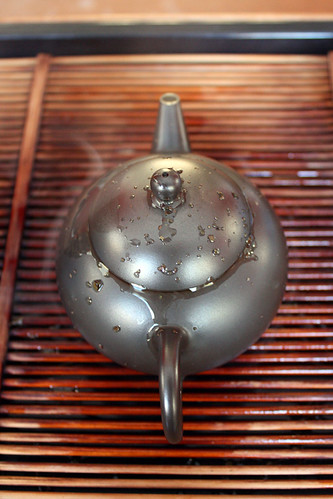
No Idea what this tea is, or the detail history... I think it is a high elevation oolong, and very old.... really well aged. Could be something more than 20 years? Looking at the leaves and smelling the dry tea, I decided to pull out my High Fired, medium thick walled Taiwanese pot.


Leaves:
1. From which vendor, farmer, source.
Stéphane
2. Date of Harvest
Unknown
3. Elevation
Unknown
4. Soil based
Soil not rock
5. Which area
Lishan or Dong Ding
6. Kind
Traditional Oolong
7. Fired level
High
8. Bush age
30yrs +?
9. Grade
medium high
10. breathing tea before brewing
1 week

Brewing vessel, water:
1. Water source
Poland Spring
2. Aged or fresh
Fresh
3. How you boil your water
Electric
4. Temp. for the first 5 steeping
Full Boiling
5. What kind of brewing vessel
Taiwanese clay/high fired/15 yrs old
6. What kind of cup to drink from
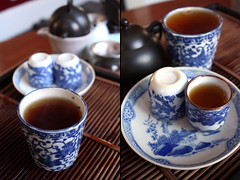
Small Japanese Sometsuke 18th Century.

Brewing Parameter:
Amount of leaves / half pot
Rinse time / Flush
Set time / 3mins
Infusing time / flush
Height of water pouring / 9 inches
hitting spots / rim

Result of the brew:
Color / Bright Brandy
Aroma / Chinese medicine. Chan (aged) smell
Texture / Light, clean
Mouth feel / Sweet and refreshing, hitting the sweet spot back of the throat
Effects of the brew / Great mellow chi, like drinking a sheung aged puerh
how many brews / 20s an on going

Weather:
Drinking time of the day / Sunday, 40 degree, 2pm ish
High/low humidity / 50s
Rainy, Snow or sunny / Sunny with snow on ground, light wind.

Afternotes:
1st brew tasted like a vintage puerh, even smell like one. I prefer the effect of the brew after drinking and a nice dry cup smell, more then the initial front of mouth taste.
2nd brew is minty, clean and refreshing, with intense floral started to build up at the back or the throat
3rd brew is amazing fresh sweet prune. Floral, Youth, Pure high mountain shower, light but complex, magnolia flower, very fresh effects
4th on aged citrus peel and lingering sweetness.

Thanks again to Stéphane for another wonderful High Quality Taiwanese traditional tea.

Monday, January 26, 2009

Kung Hei Fat Choy!


Happy New Year of a Bullish Market to Everyone! Fat Choy, Fat Choy!

Tuesday, January 20, 2009

01-20-2009


"You can always count on Americans to do the right thing - after they've tried everything else." - Sir Winston Churchill

Monday, January 19, 2009

An hour, 45 mins of education.....

Too often, the tea room is also my only smoking heaven... due to the marriage certificate which I signed: "I agreed to confine my smoking habits inside our home to a small area...." This passed weekend, during my one-and-a-half relaxing moment, my smoke once again enlightened me about tea drinking.

Cigar, like Raw puerh should be aged. This has been a fact outside the US. because of the US. embargo to Cuba, most smokers in the US could only enjoy Pure Dominican Republic as the closest alternative to fine Cuban. The gage and length of a stick usually determines the amount of time to consume one. The thicker the gage the longer it takes. I normally consume at least one a day, and my choice is usually a Robusto 5 1/4 x 52 which lasts for an hr/10 mins to 2 hrs. Funny to say, a tea session for me also equals around an 1 hr to 1 1/2.

Why do we age cigar and what is the difference between Cuban and DR? These are the heated topics in the US cigar circule. Like Puerh, most fine cigars have to be aged to marry and refine its flavor and balance. It also went through aging periods like puerh:
1. First consuming period - Production to 3rd week.
2. Sick period 1st month - 6 months.
3. 1st maturation period around 5 yrs.
4. 2nd Maturation period 15-25 yrs.
5. 3rd Maturation period 50+ yrs.

A good cigar is a combinations of 3 materials: Filler, Binder and Wrapper. Like good receipt puerh, for example 8582 from 1982, is also a combination of a couple of mountain and grades, mostly medium and spring harvest. If you drink a newly made 8582, it is bitter, astringent, unbalance and rough. Same as a Cuban Montecristo Number 2, which has a range of 1 yr - 5 yrs aged layers, if consumed in the first yr, the ashes are dark and rough, powerful but unbalance. But if you have a 1982 Monti 2, it will be heaven on earth. Ashes are light grey and the draw and body is as fine as a good Bordeaux from the 80s. Paring both 8582 and Monti 2 will be quite an experience.


http://themandarinstea.blogspot.com/2006/05/8582-to-8582.html

If you try to age a DR cigar for over 10 yrs., it losses a lot of aroma, body and complexity, and ashes will be snow white, but its almost like drinking a lowland plantation harvest puerh, which had been aged for 10+ yrs. flat, sweet but without complexity. Something about the Cuban Terroir and the way they process the leaves, which gives an edge like a fine wild Yiwu.

http://www.cigartrends.com/viewtopic.php?t=1684


My choice on a snowing Sat. was a Winston Churchill (by Davidoff) Number 10. The cigar had been aged at least 3 yrs before being released to the market. I am paring with a Yiwu 06 spring harvest. Like the Yiwu, it started off with a floral and mild body, and gradually the kicks come in around 2/3 stage. Feeling the harshest from the smoke and the vigor body of the Yiwu, I decided to tone them down by using water boiled from a new tetsubin using wood burning fire. It took a full pot to boil in less then 3 mins. and the Cast iron kettle kept it hot for another 30 mins! The tea makes a scholastic turns, smoother texture, full body and complex, which you can kind of taste every layers from the high to the low tone of the tea. Moreover, it helps to balance back the spicy, cider, full leather taste of the smoke! Loving it. The stages and timing of the full sessions work like clockworks, playing the balance and evening out each other flaws. Hope Michael could appreciate this kind of paring on our next tea meeting?


Reference: Ron NEE - "An Illustrated Encyclopedia of Post-Revolution Havana Cigars", Tang SeeHu - Puer Tea
http://www.cigartrends.com/cigar_types.php

Friday, January 09, 2009

Paring Yixing to Tea....


Picked up a new hobby at the Tea Gallery the other day. Michael has been pairing yixings with different teas to find a match before clients purchase them. This is an idea which has been around from the beginning of this culture.

If my memory serves me right, the first time I heard of it was around 1996. An old pot master retiring in Hong Kong had planted this seed in my head, while we shared a cup of Red Label. He mentioned: "If you start understanding this tea, you should understand how and what this tea is brewing from also... there is a small Universe around us at this moment, we created it by understanding each element in it." Tough Love! I recalled.

Pairing Yixing is not a easy task.... tell me about it. 1st, you have to understand how they make the pot, why the craftsmen do this and that, style, shape, size, thickness, joints, holes sizes.... 2nd, you have to understand clay, what kind, mine, age, generation, process and how it's fired.... 3rd, The history of the pot, why it is made, who it is made for, and what was in it before.... then you have to know your tea! further on, how you made your tea!!


Recently, I picked up calligraphy which inspired me tremendously. Thinking about each character style as a single pot, and how this character could become a composition. Just like how a tea pot could create a good tea moment.


Anyhow, at the end of the day at the tea gallery, we both found out this little 90 ml Square Jade YuYee could provide a better Yin yun to puerh. Jackpot!

Monday, January 05, 2009

The Mandarin's Tea


Having a tearoom at home is like having a painting studio for artists. A space to be inspired and a place to practice. This blog started only because of this red room. It is too often that the little space was not used to its fullest or even neglected. Paging through old Qing's painting, scholar, hermits and mandarins was usually illustrated into the composition, so why so empty here?

As a new year resolution, I will invite more and more like-minded tea scholars to gather and waste an afternoon in it. My first victim was MarshalN, I was lucky enough to steal him out of his hectic schedule and prolong jet legs from Asia, to join me for a couple of hours of a tea adventure. Although I miscalculated my poland spring water delivery dates and we ended up with filtered water, it ended all our tea in sour notes. The time we spent was certainly sweet. Here was the menu:


1. Puerh Worm Poop Tea from Hong Kong wet storage (courtesy of Mr. M).
2. My wet storage pu poop tea, fresh off the bing.


3. 2005 Feng Xing High Mountain 2300m brick
4. 2005 Wuyi 200 yrs old brush SX
5. 2008 Anxi high fired TGY


6. 30 yrs Lui An (from the day before)

While drinking, we shared a book on the facts of aging cigar: Min Ron Nee's Illustrated Encyclopedia of Post- Revolution Havana Cigars, which encourages lots of interesting points in the way pureh could be aged. My next step is to convince him to smoke one... and that already being proven a very challenging idea. I am very thankful and happy that this Mandarin's tea room started off with a good company, and what will be more appropriate than to end the day with a Montecristo Edmundo.


Michael from the tea galley could be my next victim.... hmmm.

Friday, December 12, 2008

How to Test a Real Zhu Ni?

Use it in the Winter time and do not pre-heat the pot. Pour hot water in and MONEY!


Down the drain! Never use a zhuni pot in a cold environment! It will be worst then our economy : P

Even Michael at the tea gallery learn it the hard way.... Click! Holly!! and all our hearts broken.
You MUST warm up the pot slowly no matter what.

So I started painting a tea pot and smoke away, hoping the smoke will claim this intense atmosphere. We all learn....

Monday, December 08, 2008

Eat, Smoke, Drink, Family.....


The Sum of a short trip to Singapore.


But nothing compare to a breakfast with my folks on a local roadside eatery. Bak Kut Teh! "Meat, Bone, tea". The best part was making Traditional Kung Fu tea on the spot! Free water with live charcoal stove at your leisure. Heaven!

Friday, November 21, 2008

Faith to follow, or to Shepherd?

In a not-so-ancient time (Ming - Qing Dynasty), when mandarins gathered for tea, the focus was most often not on the tea itself but on the free association of minds. Delicate and graceful moments in time and space were created over pots of tea—vast enough to glimpse the past, present, and future, and perhaps also affect and alter one's reflection of oneself.

I spent three days in San Francisco this past week. Brian Kirbis (http://xiaolaoke.livejournal.com/)(http://the-leaf.org/Issue3), was kindly introduced to me (online, of course) by Jason Fasi, aka bearbearbear (http://puerh.blogspot.com/). Brian the Shepherd was kind enough to take his precious time, a day before leaving for Yunnan on an important research trip, to meet with me over a cup of tea.


He arrived at my place just shy of 3 o' clock. The spiritual journey began once the doorbell rang... the door opened and upon greeting, I felt somehow that I had known this gentleman before. I unconsciously burst out with a hearty laugh: presented to me was a solid wooden chest, about 20 inches by 20 inches, with Japanese-crafted hardware and a Ginko engraved lock. "How did you manage to get through security with that?" I exclaimed, "That would be a pretty tough feat to handle if we were meeting in NYC". The positive energy from this chest and its master was radiant and immediately warmed the room.

Faith had brought us together to this moment; and once again, tea was the vehicle that had caused the connection. (I do think this friendship would be a good raw puerh).

Brian had a mission, a positive aim to help the world understand the importance of humanity through tea (in this case, puerh). Cooked (human needs) and Uncooked (nature)—abstract words, perhaps, but they are in every drop of tea. A craving for the cognitive? A medicine for the mind or body?

I was enlightened only a week ago, and concluded that there is only Good tea and Bad tea: Good tea is the concept of how the tea benefits one at the moment or in the future, and how it makes one feel and contemplate. Bad tea is known only through experience; and once one has built this memory, one builds an immediate response when drinking a Bad tea from having had enough of it in the past—perhaps like an inner alarm or firewall.

The Chest opened—cosmos or tea capsule? Antique cups, teaware, fine tea, and experience all fit neatly into ths 20 by 20 space. "I can only contribute water..." I offered. We drank three teas in this short time: 1. Lao Ban Zhang, 2. Nannou, and 3. 80's Chang Ning. I won't detail the nuances or complexities of these teas; it would be too insignificant. All that must be said is that they were Good teas.


Brian will be in Yunnan for the next two months, living with his new family (tea farmers) in the mountains and furthering his studies for the Yunnan University regarding the Essentialism of Modern Tea Society. Maya Angelou once said: "When you get, give. When you learn, teach." Brian and I understood this idea through tea; it is another wonderful gift of nature conveyed through a single leaf.


Two days before this trip, I found my newly designed project in the mail: "Footprints In The Snow: The Autobiography of a Chinese Buddhist Monk." I do think that all things are connected through karma—and this is yet another of them. The book fit nicely into the small space left empty in Brian's chest. "I always want to fit an old man into this chest," Brian said, accepting this small token. "I will be faithfully following your chest in its development," I replied.

Best of luck, and have some good tea, my friend.


A gift from Brian: A Malaysia stored 7542 from the 90s. Aging inside my silver box, until we both meet again.

Sunday, November 02, 2008

Hong So Sul, making Good Korean tea for 50 yrs.


An interesting article From Segye Korean Newspaper. Regarding modern Korean tea, roughly translated for your viewing pleasure:

Hong So Sul, master of Korean green tea, has been spending more than 49 years to make good tea in Korea. He devoted himself at Hwagae market and Hadong where most of Korean green tea is cultivated. When he first started tea cultivation in 1960, there were many tea farms in Hwagae but no one understood its true value. Hong was the one who realized the value of the tea and helped the farmers earn high income from tea farming.

Hwagae Jae Da, the tea that Hong is producing in Hwagae, was selected as the best tea in 1995 and 2001 by Korea Tea Association and won silver medal at the World Tea Competition held in China in 2001. Besides these, he was awarded with more than 10 times for his green tea. Now more than 70 years old, he still insists on steaming nine times and rubbing nines times all by hands. Korean persimmon leaf tea is what he first developed. He became a Bamboo dew tea production master and was awarded in recognition for his distinguished work.

Born in KyungBook, he went to Japan with his father at 2 years old. He came in contact with Japanese tea culture until he turned 17 and came back to Korea. He was 27 when his garment business failed and lost everything within 3 years. One woman who was supposed to pay him back for some garment gave him some green tea instead of the money she owned. He realized there's green tea in Korea as well.

He went to SaChun to produce green tea as knowing the value of green tea in Japan, but soon he was disappointed by the small size of the wild tea farms. He went to HwaGae immediately when He heard there are many large tea farms. He recalls when he found an old man from China, who makes fermented green tea for his own family, he was so glad. He started running his own tea factory in HwaGae and producing and selling wild green tea. He also educated people trying to spread his knowledge about Korean tea. As a result, after 46 years right now, 1940 farmhouses are producing 2134 tons of wild tea leaves in 931ha, making 431mil(korean won) income per year.

In the "book of tea" by Luk Yu (Tang Dynasty), it says the best tea trees are from between cliff rocks. The wild tea trees in HwaGae grow up between cliff rocks that goes around Jiri Mountains and SumJin River. They are beloved by tea drinkers because of its color and deep taste. He is recognized by his best quality green tea produced with his traditional skill by hands. He and his son's family cultivate 33000m(2) tea farms and produce 150 tons of green tea and other Korean traditional teas. Now his achievement became the province's specialty product, the town supports a Green tea Development Organization. They organize the national annual green tea festival. As a president of the organization, Hong says, many farmers are having hard time due to WTO, but we have no worries about tea because Korean tea is high quality tea with good taste and fragrance. He says Japanese & Chinese teas are large markets so it's more difficult to produce organic teas but it is possible for Korean tea because it has smaller scale market and it will raise the value of the tea. That makes it possible to compete with others teas.

Now he concentrates on handing on tea cultures to visitors at tea school next to his own tea factory. He advised that we should produce and value (中雀) & (大雀) medium/large bird's tongue more, not just high quality tea like (雨前茶) pre-rain so they can all have competition to each other and it will make all teas as universal drinks.

Thursday, October 09, 2008

Kizeamon Ido Chawan.... Impermanence.


flux, but it is as truthful as I can feel....


A Joseon (1392 - 1910) Lee Dynasty edo style? tea bowl.


Enjoy a moment of birth and rebirth from this vessel.


peace.

Monday, October 06, 2008

Parker's Wine Buyer's Guide, 7th Edition. My Idol...


Besides tea, wine is a good part of my life also. Having the greatest honor to design Parker's latest edition is a dream come true! I've been a humble follower of Mr. Parker's for over a decade now.... Hope one day we will have a moment to appreciate fine tea together. (Dream on)

This Gigantic 7th edition Hardcover and Paperback were in my mail today. What an Amazing Surprise! Thanks Jackie ; )

Thursday, October 02, 2008

A thought on Lao Ni


Lao Ni means Old Clay, or clay that had been aged before going into the kiln. I've learned from old yixing masters and most of them have recipe clay passed on by their masters and to their students, some have been aged more than a Century.

Gu Jing Zhou once said before his master passed away, they together made some pots using the master Lao Ni. The result are Masterpieces, with the finest recipe clay and tradition which will pass on for generations.

Good Recipe Lao Ni is like Jade, said master He Dao Hong... both are minerals at the end of the day. Yixing shares a lot of characters that jade has. The more you use, the more luster it will show. It will glow like Jade with human touch and get lighter by time.

These two pots in the front are from the same master, same clay and made at the same time (I guess). You can tell by these pics that there is luster shine to them, even after so many years. The funny thing is, if you cradle it inside your hands, it will suck up all the oil from your palm, glowing like a gem. Almost like when a puppy has been waiting for her master to come home all day, once you stepped inside the house, the puppy lit-up. Fun....

Wednesday, October 01, 2008

Qing's Yixing lovers


These Qing's Dynasty (1644-1911) Yixing came in pairs. Lovers or perhaps partners for over a Century. Some have been repaired, and some will remain wabi.

These are all made by the same factory: Mansheng, of course not the real person Mansheng himself. Just imitation of the master's shape. I encountered a real ManSheng pot in Hong Kong Flagstaff museum once, and was a learning experience.


This one at the center is the only one came alone.... Over the weekend, I'd transformed him to a brand new person. Here are the before and after pics. Cleaning up patina of over a 100 year-old is also a learning and humble experience.

Monday, September 22, 2008

Sharing a thought....


The Qing Brick finally ended one month after.... Still, the tea water from the steep tasted like a Edith Piaf's song.

http://www.nytimes.com/2008/09/21/nyregion/21tea.html?_r=1&oref=slogin

Courtesy of the New York Times Sunday Metro sec.

Sunday, September 14, 2008

Gaiwans


Inspired by Yumcha's Gaiwan post: Remnants of a past I decided to document some of my inventory, collected over a period of short tea time. I hope this could serve as a visual history for my future reference. Never know when will be the next victim of my floor....


I have recently stop collecting random Gaiwans, but my interests in collecting Korean pottery have grown... specially the edo style tea bowls. Thanks to MattCHa from his passion and dedication to this rare and emerging art form.

Friday, September 12, 2008

The Morning After....


My Wuyi SX finally gave after 11 days and a long last night session... or shall I say, I gave up? This morning, I tasted the last overnight steep. The fragrance still attracts my craving, it will go on and on like rose/sweet corn water if I continue.... But I guess Phyll and Sal had enough of this experience : ) Should we try a vintage puerh next... for a full month : P

anyone up for it?

Monday, September 08, 2008

Korean Style Storage


This is a gift from my lovely wife. We found a very nice tea/pottery shop in Seoul this year and this is the result of our visit, plus fond memories of course.


What's in it? Korean tea from Matt's kindness gift. What else will be more suitable? I think I will age this ddok cha at least for a year before consuming. I'll be patient and it should be rewarded by more great memories ; )

Friday, September 05, 2008

What is detail Tasting?


Per Eileen's request, I am explaining step-by-step method of "Detail Tasting". This is by no means a traditional method, practiced by tea master. It's simply a method I and Michael developed, based on our try with success and errors.

First of all, you need 3 vessels. A brewing pot/gaiwan and 2 tall cups which hold the same volume of the pot. Why two cups? The 1st is to pour the brew in, then transfer the brew into the 2nd cup for drinking. After the transfer, 1st cup becomes the smelling cup which one can appreciate dry cup smell of the fresh brew. The second one is for slow drinking, after consumption, you can then compare the dry cup smell from the 1st cup to the 2nd cup.

Always smell and look at the tea after a overnight or 2 days brew. Smell the lid first and look for signs of oil or mold developing at the surface of the filled pot. Instinct and intuition play a big part in tea drinking, at least for me. If your gut feeling tells you not to drink, then just try a tiny slurp and discard.....


A step-by-step pic. for a flush steep after a overnight session. From Left to Right:
1. Pour out the overnight brew to the first cup and drink slowly. Enjoy the smell of the dry cup afterwards.
2. Refill the pot with boiling water.
3. Close lid and seal the pot with another pour.
4. Observe the surface of the pot, until all the surface water is sucked up dry. (You kinda have to feel it for timing)
5. Pour and drink the flush brew. (Traditional Cantonese Kung Fu will always dry up the previous pot by hanging it vertically (as shown on the far right pic. This is to drain out all the remaining water from the pot before the next steep.)


PeekABoo! What's in the tub?


After the first flush steep, probably after the 3rd day of "detail tasting". I will then do a double vessel brewing for the overnight or 24 hr. steep. This double heating technique can extend the high temp. inside the pot for a longer period of time. Tea addicts will apply this technique to vintage puerh. Also works with good quality Long Jin, instead of boiling water and a yixing pot, I will use luke warm water for the brew and a gaiwan. Then fill half way up with boiling water for the outer vessel. (That will be another pots next May : )


This is the 7th weeks brew at the tea gallery. Michael used 18 grams of this 04 SX tea in this large Gaiwan for the test. The back is the 2008 harvest, on its 2nd weeks.

Tuesday, September 02, 2008

Second day of Kung Fu tasting....


The spark of the idea to search for the perfect Kung Fu oolong dated back to this post:
http://themandarinstea.blogspot.com/2006/08/what-is-traditional-kung-fu-tea.html

After a long journey to find the origin of Kung Fu tea, from Chaozhou to Anxi and Wuyi mountain in China, the frustration of a deeper understanding of what Real Kung fu means still lingers.... Until 2 years of testing and tasting with Michael at the tea gallery, the result is this SX from Wuyi San....

Second day of tasting. The tea made a turn from masculine to scholastic this morning. Cigar to floral, acacia flower fragrance to be exact. First thing I did is to taste the overnight brew: lychee and floral notes, hint of tobacco sweetness around my mouth. Following with a rush of sandalwood coating my throat, creamy apricot aftertaste. I then pour boiling water into the pot, awakening the leaves again. The distinctive aroma of this refine fired SX covered my tea room, what a talent this tea master processes.... The man who is responsible for this addiction is under 40 yrs of age!

Wuyi or Anxi (high fired) is "crafted tea", or perhaps "Real" Kung Fu tea.

Why? From picking trees to aging such tea involved skills and experience every steps of the way. The reason why this tea outlasts every others is that, the master firing had penetrated to the core of the leaves, without changing the nature of its character. Almost "preserved" it. It tastes very normal for the 08, but if aged properly (btw. Storing/aging this kind of oolong is 10 times more work than puerh.) The tea will develop like fine wine.

This is the link to the finding of this tea:
http://themandarinstea.blogspot.com/2006/08/wuyi-rock-oolong-tasting.html

After enjoying this quick steep, (Hot water in, hot water over the pot until the pot suck up the surface dry.) I refilled it again with boiling water and sealed it for tonight.

Related Posts:
http://phyllsheng.blogspot.com/2008/09/marathon-has-ended.html

Monday, September 01, 2008

A Marathon Relay Continues....


Traditional Kung Fu tea drinkers might brew only 3 steeps, ending the session in less than 30 mins. For my experience, if you can find a tea which can outlast more than a month, does that mean I have been wasting all the precious ones for my entire tea drinking life? Or is it only a mere 1 % of the tea I did crossed path with deserving this kind of treatment?

How could a tea keep on going after days of days of abuse, without fading or molding-up, but continuing to develop? Will find out how this marathon ends. The subject is more than 200 yrs old SX bush from Wuyi, refine fired 4 times from May to September 2004. The Kung Fu of this firing had penetrated into the core of the leaves without distorting the character of the tea.


3/4 filled, 1 sec. brew until the 5th brewing. Tastes like Summer mountain spring water stream, passing along the hot sun soaked moss growing next to rock. Clear, fragrant, and full of energy. What will be better to pair with an 1990 vintage Cohiba Robustos.

 
Creative Commons License
This work is licensed under a Creative Commons Attribution-Noncommercial-No Derivative Works 3.0 United States License.